

Marketing for Surveyors: What Works, What Doesn't, and Why
What actually works when marketing a land surveying company?
Instead of giving you another generic list of marketing tactics, we’re looking at what happened when we built Hawaii Surveying from the ground up with Robert Martin of Surveying with Robert.
What Marketing Works Best for Surveyors?
There isn't one marketing tactic that works best for every surveying firm. In practice, the strongest approach combines visibility, credibility, easy contact, fast response, good delivery, and proof — with the specific channels determined by the type of surveying work you want to win.
If I had to reduce everything we learned from Hawaii Surveying into one system, it would look like this:
Visibility → Validation → Contact → Response → Delivery → Proof → Referral
Visibility
Can the right people find you?
SEO, paid search, social media, relationships, vehicles, networking, referrals, and other channels can all create awareness.
Validation
When somebody checks you out, do they see evidence that you're capable?
Website. Reviews. Project examples. Credentials. Content. Real photos. Professional presentation.
This is where technical trust becomes visible buyer confidence.
Contact
Is it obvious how to reach you?
Don't hide the phone number.
Don't bury the form.
Don't create unnecessary steps.
Response
How quickly and professionally does the inquiry get handled?
Marketing generated the opportunity.
Your process determines what happens next.
Delivery
Do you actually do what you said you would do?
No amount of marketing compensates for consistently poor service.
Good marketing makes promises visible.
Operations have to fulfill them.
Proof
Are you capturing evidence of successful delivery?
Reviews. Testimonials. Case studies. Project examples. Referrals.
Don't let successful work disappear once the invoice is paid.
Referral
A good project can create the next opportunity.
And when that referred prospect checks you out online, they enter the Validation Stage and the cycle starts again.
That's why marketing isn't a collection of disconnected tactics.
It's a system.
I had the opportunity to see that firsthand while helping Robert build and market Hawaii Surveying.
Robert entered a market where he knew very few people, and we had to figure out how to make a new surveying company visible, credible, and easy to hire.
Some tactics generated leads. Some supported trust and referrals. Others never reached their potential. And some of the biggest lessons had nothing to do with a marketing channel at all.
And perhaps most importantly, the experience reinforced something I believe about marketing in general:
It's not about doing all the things. It's about doing the right things for the business you're actually trying to build.
So, rather than giving you a theoretical marketing plan for surveyors, let's look at what actually happened:
The Hawaii Surveying Case Study: Building a Surveying Business From Scratch
Hawaii Surveying at a glance:
Started in a market where Robert had only a few existing contacts
Major expected anchor project did not materialize
Website + SEO + paid search + GBP + reviews + referrals + physical branding
Less than $1,000 in discussed Google Ads spend
Roughly 40 leads
Around 10 closed or strong opportunities
Business ultimately discontinued because Robert chose to refocus on Surveying with Robert, not because demand couldn't be generated
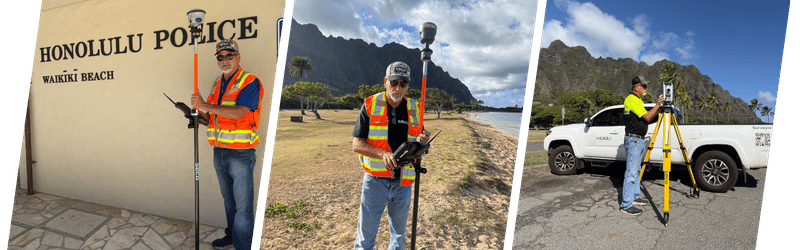
When Robert went to Hawaii, he wasn't arriving with an established local surveying business and decades of relationships on the islands.
Instead, he had a couple of contacts, extensive surveying experience, and an opportunity.
The original plan centered heavily around the possibility of a large third-party verification project connected to major work at Pearl Harbor, but that opportunity ultimately didn't materialize.
Hawaii Surveying already existed when that contract fell through, so the question changed.
It was no longer:
How do we support this major project?
It became:
How do we generate surveying work in a market where almost nobody knows us?
That's where marketing became important and ECON Marketing got involved.
Hawaii Surveying began pursuing boundary surveys, property surveys, commercial opportunities, control work, and other surveying projects.
And because Robert didn't have a decades-old referral network in Hawaii to rely on, we had to create visibility instead of waiting for it.
That experience gave us a useful real-world test of what marketing for surveyors can actually look like.
1. A Surveying Website Should Prove You Know What You're Doing
One of the strongest lessons from Hawaii Surveying came directly from a prospective client.
Robert received a call from someone who told him that one of the reasons they contacted Hawaii Surveying was simple:
The website made it look like we knew what we were doing.
That sounds basic, but there's more going on there than good web design.
The website didn't simply say:
‘We offer professional land surveying services. Contact us for a quote.’
It explained the different types of surveys Hawaii Surveying performed.
It explained what those surveys were.
And importantly, it helped visitors understand why they might need them.
That matters because the person searching for a surveyor is not always a surveyor.
They may be a:
Property owner
Developer
Realtor
Attorney
Contractor
Engineer
Architect
Project manager
Company entering an unfamiliar market
They don't necessarily need a technical lecture.
They need enough information to answer a more practical question:
Can this company handle what I need?
That is one of the most important jobs of a land surveying company’s website.
Your technical expertise may be considerable, but much of that expertise is invisible to a potential client.
The website has to translate technical capability into something the buyer can recognize.
For Hawaii Surveying, we also used real photographs rather than relying entirely on generic imagery. Robert appeared in Hawaii Surveying-branded clothing alongside the company truck. The website was kept simple, direct, fast, and usable on mobile devices.
None of those things individually won the strategy.
Together, however, they helped make the business feel real.
What worked
Clear service information
Real imagery
Straightforward messaging
Mobile usability
Fast access to important info
What doesn't work
Building a beautiful website that says almost nothing (or the same thing every other surveyor is saying).
A surveying website shouldn't exist merely to prove the company has a website.
It should help a visitor understand your capabilities, your services, your market, and why they should trust you with their project.
2. Don't Make People Work to Contact You
Getting somebody to your website is only part of the job.
Once they're there, what happens next?
One of the things we noticed while working on Hawaii Surveying was that surveying inquiries could be time-sensitive.
Sometimes people didn't simply need a survey - they needed a survey yesterday.
That makes response time commercially important.
We focused heavily on what is called speed-to-lead: reducing the amount of time between somebody expressing interest and somebody from the company responding.
At one point, the Hawaii Surveying website had a prominent yellow button that essentially said:
Talk to a Licensed Surveyor Now.
There wasn't much ambiguity. If you needed a surveyor, there was the button.
The website also included a contact form that sent notifications to multiple relevant people so that an inquiry wasn't sitting unnoticed in an inbox.
The idea was simple:
If someone is ready to talk, don't make them hunt around the website to figure out how.
Marketing doesn't stop at the click
This is where a lot of marketing advice becomes incomplete.
Getting more traffic isn't enough. Generating a lead isn't enough.
The process after the lead arrives matters too.
If a potential client contacts three surveying companies and one responds quickly while the other two respond tomorrow, the fastest company may have created a significant advantage before anyone has even discussed the project.
So your marketing process needs to consider the full path:
Visibility → Interest → Contact → Response.
Every unnecessary step creates another opportunity for somebody to disappear.
3. SEO Builds Visibility Where People Are Already Searching
We also worked on making Hawaii Surveying visible through organic search.
The website was optimized around relevant surveying services and locations, and during the period we discussed on the podcast, we saw the company gaining visibility for searches around surveyors in places such as Maui and Honolulu.
This is particularly important for surveying companies because there is already search demand for many services.
Someone may search for:
Land surveyor near me
Boundary surveyor
Property survey
ALTA survey
Topographic survey
Construction staking
Surveyor in [city]
Land surveying company in [location]
You aren't necessarily trying to convince that person they need surveying, because they already have a problem.
SEO for your land surveying firm makes your website visible while they're looking for the solution.
But SEO also takes time.
A brand-new website doesn't automatically outrank established local competitors just because it is well optimized.
That's where another channel helped Hawaii Surveying.
4. Google Ads Helped Us Buy Visibility While Organic Visibility Developed
We used paid search alongside SEO, and the roles were different.
SEO was intended to build longer-term organic visibility.
Google Ads allowed us to appear for relevant searches more immediately, including situations where Hawaii Surveying wasn't yet ranking organically at the top of the results.
During the period discussed in our podcast, Hawaii Surveying spent less than $1,000 on Google Ads in 2025 (which, we only began running in October, so we averaged about $300 a month in ad spend).
We generated roughly 40 leads from that activity.
Around 10 were remembered as either closed projects or particularly strong opportunities.
Those numbers should be understood in the context of a relatively short campaign and a business that was still being built from scratch, but the important lesson isn't simply:
Google Ads work for surveyors.
The lesson is that paid search made sense for the particular problem we had.
There were people actively searching for surveying services.
Hawaii Surveying was new.
We couldn't manufacture years of organic search history overnight.
So we bought targeted visibility while building everything else around it.
What worked
Using paid search to capture existing demand while the organic presence was still developing.
What doesn't work
Running ads simply because somebody told you every business needs Google Ads.
Paid search works best when the intent, geography, services, economics, and landing experience make sense.
One completed surveying project may justify a meaningful amount of advertising spend.
But that doesn't mean every surveying service should be advertised in every market.
The economics have to work.
5. Your Google Business Profile and Reviews Are Part of the Validation Stage
A person finding your company isn't necessarily ready to hire you immediately.
They may have:
Heard your name from somebody else
Seen the truck
Found you on Google
Clicked an ad
Saw you on social media
Then something happens before the phone call.
They check you out, essentially validating your company.
That’s why I refer to this as the Validation Stage.
It is the space between becoming aware of a company and deciding whether that company is credible enough to contact.
A potential client might:
Visit your website
Search your company name
Look at your Google Business Profile
Read reviews
Check social media
Look for project examples
Verify your services or credentials
Compare you against another surveying company
This is why marketing channels shouldn't be treated as completely separate activities:
Your website might generate the initial impression
Your reviews may validate it
Your Google Business Profile may reinforce that you're established
Your social profiles may show activity
Your project information may prove capability
Together, they answer the question:
Can I trust this company with my project?
With Hawaii Surveying, we made a conscious effort to build reviews instead of simply hoping they appeared.
After jobs were completed, Robert could send customers a direct link that made leaving a Google review simple.
Again, the principle was reducing friction.
Don't tell a happy client:
Go find our Google Business Profile sometime and leave us a review.
Give them the link.
Make the next step not only obvious, but frictionless.
6. Marketing and Referrals Are Not Opposites
Surveying has traditionally been a heavily referral-driven business, and that isn't going away, nor should it!
Good relationships, reputation, technical competence, responsiveness, and quality work can generate business for years.
But there is a mistake in thinking that the choice is:
Marketing OR referrals.
In reality, they frequently reinforce each other, and Hawaii Surveying gives us a good example.
Robert completed a project connected with a real estate professional who was impressed enough with the work to send an email recommending Hawaii Surveying to other people on the team.
That's referral marketing.
But the initial opportunity had to come from somewhere.
Marketing can generate the first project.
Good work creates the positive experience.
That experience creates the referral.
Then the person receiving the referral may search the company's name, visit the website, read the reviews, and go through the Validation Stage before calling.
The cycle begins again.
This is why I don't view marketing as a replacement for word of mouth.
Good marketing can help create the conditions from which more word of mouth develops.
7. Your Truck Is Marketing Too
Some marketing happens nowhere near a computer.
Hawaii Surveying had a branded truck.
And according to Robert, the truck itself generated a couple of phone calls.
That shouldn't be surprising.
Surveyors are field-based professionals with trucks, crews, and equipment which are all visible by people.
The way your employees interact with property owners, contractors, neighbors, and other people on (and off) a jobsite is visible, especially if they have your business on their shirts, hard hats, and vehicles.
All of that contributes to how the market perceives the company.
Robert even had a QR code on the back of the truck that linked to the Hawaii Surveying website.
So somebody could:
See the truck → recognize the company → visit the website → submit the form → call a surveyor.
That is marketing.
And it highlights something that gets missed when marketing is reduced to SEO, advertising, and social media.
People form opinions based on everything they can see:
The condition of your vehicle
The professionalism of your crew
The way somebody speaks and smells
The quality of the deliverable
The speed of your communication
The way the truck looks when it arrives
These things may not appear in your marketing budget, but they affect your reputation.
Your brand isn't only your logo
A logo is a visual identifier, but a brand is the collection of expectations people begin attaching to that identifier.
If your logo is on the truck, then everything that truck and its crew represent starts contributing to the brand.
That can work in your favor or against you.
8. Social Media Can Work for Surveyors, But It Isn't Automatically the Answer
We created social profiles for Hawaii Surveying, including Facebook, Instagram, and LinkedIn.
They began creating some traction and contributed traffic to the website, but we never really had enough time or usable content to build significant momentum.
And Hawaii Surveying had a particularly unusual obstacle:
A lot of Robert's most interesting work couldn't be photographed.
Some projects involved highly restricted locations where taking pictures simply wasn't an option.
That's a useful lesson because generic social media advice might tell a surveying company:
Post photos from every project.
But what if you can't?
What if:
Your clients don't want their sites published?
You're working around sensitive infrastructure?
The most work isn't visually understandable to the average person?
Marketing has to fit the reality of the business.
That doesn't mean social media becomes useless.
It means the content strategy changes.
A surveying company could instead create content around:
Educational explanations
Surveying technology
Frequently asked client questions
Team members
Equipment
Non-sensitive projects
Industry observations
Community involvement
Common surveying misconceptions
Behind-the-scenes processes where appropriate
Lessons from unusual projects without revealing confidential information
The point isn't to post because somebody told you the algorithm wants three posts per week.
The point is to use the channel when it helps the business communicate something useful to the right audience.
9. Relationship Marketing Still Matters
Not every surveying opportunity begins with Google.
Relationships are still enormously important.
For Hawaii Surveying, we discussed building relationships not only with other surveyors but with people in industries that regularly influence surveying work.
That can include:
Realtors
Developers
Engineers
Contractors
Attorneys
Architects
Title professionals
Property professionals
Municipal or institutional contacts
The objective shouldn't simply be to show up and ask for referrals.
A stronger relationship is built when the surveyor becomes useful.
Can you:
Educate someone about when a particular survey is necessary?
Help an engineer understand what information you need before a project starts?
Help a realtor explain the difference between two survey types to a client?
Become the person they trust enough to call when they have a question?
That's a relationship, and relationships create referrals far more effectively than endlessly asking people for them.
10. Not Every Surveying Firm Should Use the Same Marketing Strategy
This may be the most important lesson in the entire article:
There is no universal best marketing strategy for land surveyors.
Why?
Because not every surveying company is trying to win the same type of work.
Consider two firms.
One primarily performs residential boundary and property surveys for homeowners.
The other wants commercial development projects from engineers and developers.
Calling both companies “surveyors” doesn't mean their marketing process should be identical.
A residential or property-focused surveying company
Search visibility may be extremely important because individual property owners frequently begin with Google.
That can make:
Local SEO
Google Business Profile
Reviews
Service pages
Location pages
Paid search
Fast contact
Clear explanations
particularly valuable.
A commercially focused surveying firm
A company targeting engineers, developers, architects, contractors, or large organizations may depend more heavily on:
Relationships
Reputation
Business development
Capability statements
Case studies
Project experience
Specialized technical content
Professional networks
Direct outreach
Strategic visibility
Google can still matter, but the buying process may look very different.
A specialist geospatial firm
A business selling highly technical scanning, mapping, drone, monitoring, or looking to market geospatial services may have to educate the market before a buyer even realizes what solution they need.
Content and technical authority can therefore become much more important.
Intent defines process.
Before asking which marketing tactics you should use, ask a more important question:
What kind of work are we trying to win, and how do the people buying that work actually choose a surveying company?
The answer should determine the marketing strategy.
What Didn't Work for Hawaii Surveying?
A useful case study shouldn't only talk about the successes.
Several things didn't happen the way we originally imagined.
The major anchor opportunity disappeared
The large project that helped make Hawaii attractive in the first place did not materialize.
That forced the business to generate demand elsewhere.
It also reinforced the danger of depending too heavily on one opportunity.
A large contract can be fantastic.
But one contract isn't a market.
Social media never reached its potential
The accounts existed, and there was some traction, but limitations around photographing projects made consistent content creation difficult.
That doesn't prove social media doesn't work for surveyors.
It proves the marketing strategy has to fit the operating environment.
Some opportunities came too late
Robert also encountered projects where existing contractual arrangements meant the surveying work was already effectively spoken for.
Visibility helps you compete for opportunities.
It cannot always reopen an opportunity after the buying decision has already been made.
Being known before the project appears can therefore matter just as much as being discoverable once somebody starts searching.
And ultimately, Robert wanted to build something else
This is probably the most interesting outcome.
Hawaii Surveying was working, and Robert believed the company could have continued growing if he had stayed and focused on it.
But doing boundary surveys in Hawaii wasn't ultimately what he wanted most.
After decades in surveying, Robert's real passion was increasingly around teaching, training, knowledge transfer, and Surveying with Robert, and that distinction matters, because the purpose of marketing is not simply to generate more leads.
It is to generate opportunities that support the business you actually want to build.
You can have technically successful marketing that creates commercially unattractive work.
You can build demand for a service you don't enjoy delivering.
You can fill a pipeline with projects that don't fit your long-term direction.
More leads is not automatically better marketing, better marketing creates the right demand.
You Don't Need to Do Everything
This might be the biggest misconception around marketing a surveying company.
You don't necessarily need:
Every social platform
Every advertising channel
Daily content
A massive website
Constant email campaigns
Expensive branding exercises
Every marketing tactic somebody on the internet recommends
What you need is clarity:
Who are you trying to reach?
What type of surveying work do you want more of?
How do those buyers find surveyors?
What do they need to see before they trust one?
What prevents them from contacting you?
What makes them choose one firm over another?
And once you win the project, what creates the next one?
Answer those questions first. Then choose the marketing.
The Real Lesson From Hawaii Surveying
When Robert arrived in Hawaii, very few people in the local market knew him.
His experience didn't automatically transfer into local reputation.
The equipment didn't automatically generate projects.
The technical capability wasn't automatically visible.
Marketing helped close that gap.
The website demonstrated knowledge.
SEO helped create organic visibility.
Google Ads put Hawaii Surveying in front of people already looking for surveying services.
Reviews created proof.
The truck generated awareness.
The contact process reduced friction.
Fast responses helped turn interest into conversations.
Successful delivery created referrals.
None of those things replaced surveying expertise.
They helped people see it.
And that may be the simplest explanation of what good marketing does for a surveying company.
It doesn't turn an average surveyor into a great one.
It helps the right people understand why a good surveying company is worth calling.
There is a simple analogy Robert Martin likes to use when talking about marketing: “You can have a great pickup truck sitting in your front yard. But if there isn't a for-sale sign on it, nobody knows you're trying to sell it.”
Land surveying businesses can have exactly the same problem.
You can be an exceptional surveyor. You can have decades of experience, expensive equipment, impressive technical capabilities, and the ability to deliver work that is better than many of your competitors.
But if the right people don't know you exist, none of that guarantees you opportunities.
That's where marketing comes in.
Not as a replacement for reputation, referrals, relationships, or good surveying.
Marketing helps make those things visible: You can own the best truck in town, but somebody still has to know it's for sale.
This article is based in part on my conversation with Robert Martin of Surveying with Robert about the building and marketing of Hawaii Surveying:
If you're building, growing, or repositioning a surveying or geospatial company and want a marketing strategy built around the work you actually want to win, ECON Marketing helps technical firms turn their expertise into visible market advantage.
Click below to connect with me today:

Frequently Asked Questions About Marketing for Surveyors
What is the best marketing strategy for land surveyors?
There isn't one strategy that works for every surveying company. The best approach depends on the type of work you want, your target client, your geography, your competition, and how those buyers search for and select surveyors. Local SEO and Google Business Profile may be particularly important for consumer-facing work, while relationships, reputation, case studies, and business development may matter more for commercial surveying.
Does SEO work for land surveyors?
SEO can be particularly useful when prospective clients are already searching Google for surveying services in a specific geographic area. Service pages, location relevance, useful content, Google Business Profile optimization, reviews, and a technically sound website can all support organic visibility.
Do land surveyors need Google Ads?
Not necessarily. Paid search can be useful when there is strong search intent and the economics of the work justify the acquisition cost. For a new company, Google Ads can also provide immediate visibility while organic search rankings are developing.
Should surveying companies use social media?
Social media can help surveying firms build familiarity, showcase expertise, communicate personality, recruit employees, and stay visible to clients and industry contacts. But it shouldn't automatically become the center of the marketing strategy. The platform and content need to fit the firm's audience and operating reality.
Are referrals still important for land surveyors?
Absolutely. Marketing doesn't replace referrals. It can support them by making the company easier to discover and easier to validate. Marketing can also create the first project that later generates repeat work and referrals.
What should a land surveying website include?
At minimum, a surveying website should clearly explain the firm's services, geographic coverage, capabilities, experience, and how to contact the company. Useful explanations of different survey types, project evidence, real imagery, credentials, reviews, and clear calls to action can also help potential clients evaluate the firm.
How much should a surveying company spend on marketing?
There is no universal number. Marketing spend should be evaluated against the value and margin of the projects you're trying to acquire, the competitiveness of the market, your growth objectives, and your existing sources of business. The better question is whether the investment produces the right opportunities at commercially sensible economics.
Can marketing help a new surveying company compete with established firms?
Yes, but marketing cannot manufacture technical competence or reputation overnight. What it can do is make a capable new firm easier to discover, understand, evaluate, and contact. Hawaii Surveying demonstrated how a combination of website content, search visibility, paid advertising, reviews, physical branding, relationships, and responsiveness could help a new surveying business gain traction in an unfamiliar market.